Impact signals
The boundary layer is associated with elevated iridium, shocked quartz and tiny glassy spherules formed by impact ejecta. These markers appear far beyond Mexico, which is why the event is understood as global rather than local.
66 million years ago
The Mesozoic closes at the Cretaceous–Paleogene (K–Pg) boundary. Rocks worldwide record a geochemical fingerprint of catastrophe followed by a reshuffled biosphere in the Paleogene.
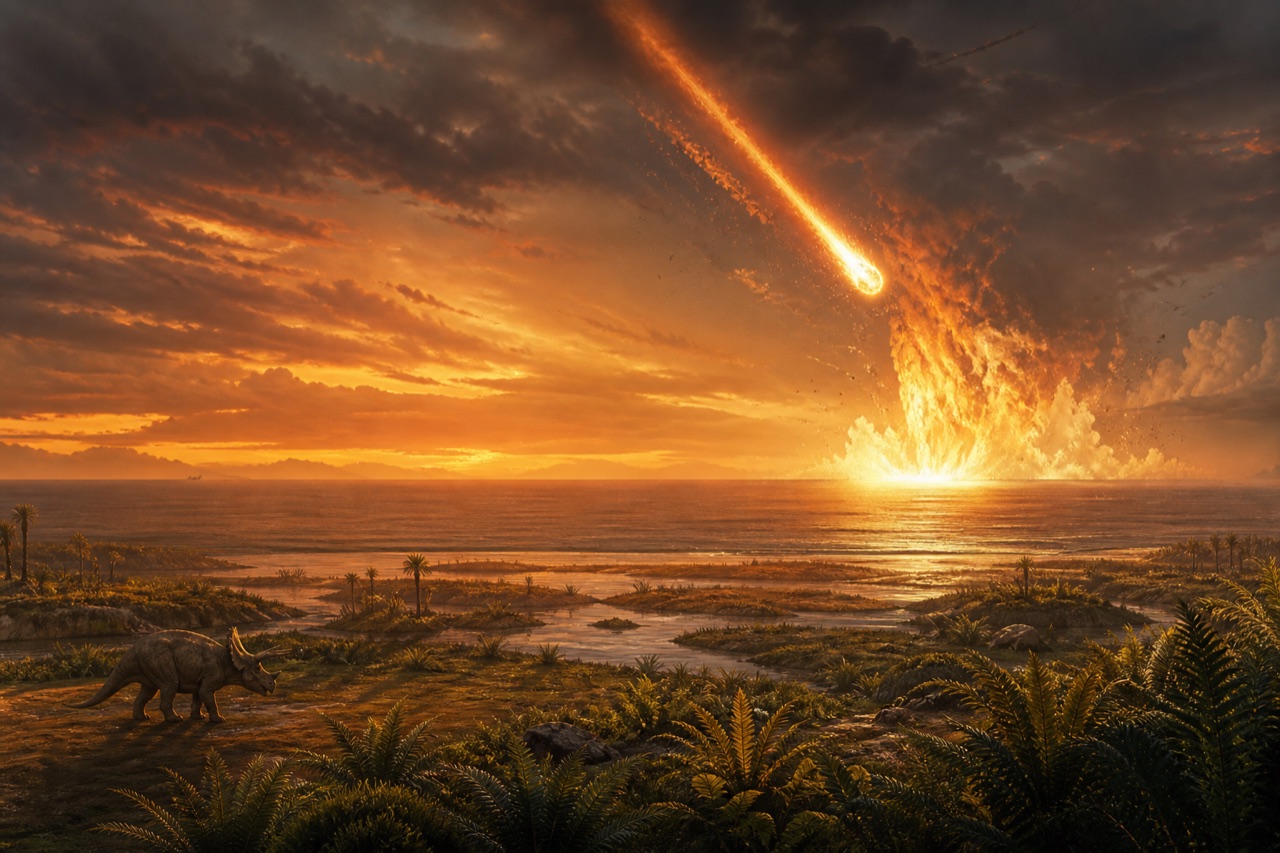
A buried crater beneath Mexico’s Yucatán Peninsula aligns in time with the boundary. The impactor struck shallow marine carbonate and evaporite rocks, lofting dust, soot, and climate-active gases. Models describe a brief thermal pulse, global wildfires in some scenarios, acid rain, and longer-lived “impact winter” cooling from aerosols—stressing photosynthesis-based food webs on land and in surface oceans.
Massive flood-basalt eruptions in what is now India were underway across the late Cretaceous. Volcanic outgassing can warm climate with CO2 and cool it with sulfate aerosols, while altering ocean chemistry. Current research debates how much the Deccan province preconditioned ecosystems before the impact versus how much the impact shock alone explains the pattern of extinction selectivity.
Lost or severely culled at the boundary (examples): non-avian dinosaurs, pterosaurs, many marine reptile lineages, ammonites, and belemnites, among others. Survivors include: birds (avian theropods), mammals, crocodilians, turtles, lizards and snakes, amphibians, ray-finned fishes, sharks, and many invertebrate groups. The survivor list is not random: body size, diet, habitat buffering, and life-history traits all correlate with fossil recovery in the first million years of the Paleocene.
The K–Pg layer often contains elevated iridium—rare on Earth’s crust, more common in asteroids—plus shocked quartz and spherules linked to impact ejecta. Fossil records show abrupt turnover in plankton and abrupt shifts in terrestrial plant communities in some regions, followed by mammal and bird diversification in the Cenozoic.
The end-Cretaceous extinction is reconstructed from many independent lines of evidence, not one dramatic illustration.
The boundary layer is associated with elevated iridium, shocked quartz and tiny glassy spherules formed by impact ejecta. These markers appear far beyond Mexico, which is why the event is understood as global rather than local.
The most damaging phase may have been what happened after the impact: darkness, cooling and a major reduction in photosynthesis. When primary productivity crashes, terrestrial and marine ecosystems can fail from the bottom upward.
Deccan Traps eruptions were already underway late in the Cretaceous. They likely affected climate and atmospheric chemistry before and around the impact interval, even if the asteroid remains the sharpest extinction trigger.
Birds, crocodilians, turtles, many fishes and many small-bodied organisms made it through. Survival patterns suggest that habitat buffering, body size, diet flexibility and ecosystem structure all influenced who persisted into the Paleogene.
Minutes to hours: impact, ejecta, shockwaves, tsunamis and regional devastation.
Days to months: dust, soot and aerosols alter sunlight and climate.
Years to decades: plant productivity and food webs are severely disrupted.
Longer aftermath: ecosystems rebuild under new Paleogene conditions, with mammals and birds expanding.
The K–Pg boundary is one of the clearest case studies of how geology, atmosphere, climate and ecology interact. It is not only the end of iconic dinosaurs, but a lesson in how tightly connected Earth systems can be.
These questions come up constantly because the K–Pg event sits right at the border between public imagination and active scientific debate.
No. Some effects were immediate and devastating, but the full extinction pattern unfolded through chained environmental consequences: ejecta, atmospheric disruption, reduced sunlight, food-web collapse and ecological instability.
Late Cretaceous volcanism clearly mattered, but the sharp global boundary signals still strongly support a central role for the Chicxulub impact. The best current picture is often a combined-stress model rather than a simplistic one-cause story.
There is no single perfect answer, but small body size, ecological flexibility, some seed-based food options, and the kinds of habitats certain bird lineages used may all have helped. Survival was likely a matter of multiple overlapping advantages.
Marine extinctions also show abrupt boundary turnover, but recovery and loss patterns differed among groups. As on land, the real picture is ecological collapse filtered through different body plans and food webs.
Because science is not only about identifying a trigger. Researchers continue refining timing, regional impacts, volcanic effects, ecological selectivity and the pace of recovery. The broad outline is strong; the internal mechanisms still reward careful study.